-->

Update:

Updated 2 June 2020 - New blog post - A walk down Briton Ferry Canal

Wednesday, 3 June 2015

Day 3 - 30 Days Wild - Kestrel on my doorstep!

Well what a difference a day makes! The weather today was fantastic compared to the last few days and you have to admit everything looks that little bit better in the sunshine. 

Being in work most of the day, I kept looking out of the window and couldn't wait until 5.30pm when I could swap my computer for a pair of binoculars.

We didn't want to travel far to spot some wildlife and I am very fortunate that I live near a lot of woodland and a lovely canal. So we took an evening walk down the canal to see what wildlife was around. 

The canal looked beautiful with lily pads.
So many bull head lilies on the canal right now.

There are some old industrial buildings near the canal and we were treated to the sight of a family of goldfinch. It was so sweet to see the adult feeding the fledglings.

Goldfinch with fledglings
The canal was full of different flowers, from the lily pads in the water to irises on the banks - it just looked so beautiful and thriving with plant life.

The plants around the canal
Yellow Iris
A purple orchid
We walked down the canal and were greeted by swallows that skimmed the water for midges (but were impossible to photograph).

A little further along the canal we could see a bird perched on a electric pylon cable - it was quite far away, but when we zoomed in on our cameras we were amazed to see that it was a kestrel! This was the first time I have ever seen a kestrel in Briton Ferry, Neath and was so excited when it started to fly and hoover over its prey. I managed to get a picture (sorry its a bit blurry) and some video.

A kestrel!


We were so happy with what we saw that we started to make our way back home (plus we didn't want to miss Springwatch). On the way back we saw some more birds including a moorhen camouflaged in the reeds, a few mallards and a juvenile robin singing it's little heart out.

The canal is on the right hand side, the river Neath is on the left
Moorhen
A juvenile robin
A female mallard
So what a fantastic day 3 of our 30 Days Wild - to think there's a kestrel literally a quarter of a mile from where I am sitting now has just made me ecstatic and can't wait to venture back down to see if I can get better photos. 

The weather is still looking good tomorrow, so roll on day 4!

Tuesday, 2 June 2015

Day 2 - 30 Days Wild - Turning over a new leaf!

Well the rain continued to fall all through the night and there was no improvement this morning. So once again we ventured on our usual walk to work, trying not to get my camera wet on the way.

Every morning we cross a footbridge over a busy road and it is amazing how overgrown the trees have become the last few weeks. I must confess I am not really up on my tree identification so I decided what I would do today is to collect some leaves, take some pics and try to identify them.

This is how I got on...

The footbridge surrounded by deciduous* trees
(*deciduous means when a tree loses their leaves seasonally, usually autumn)
Sycamore (Acer pseudoplatanus)

Not really native to the British Isles, it was introduced into the UK in the Middle Ages. This deciduous tree can grow up to 35m and can live up to 400 years. The seeds you will probably know as 'helicopters' and as a kid I remember throwing them up and seeing then spin to the ground.

In Wales, sycamore is traditionally used to make love spoons.

Common Ash (Fraxinus excelsior).

A native, common and widespead deciduous tree that can grow up to 35m tall. It produces tiny clusters of flowers that turn into winged fruits in late summer and autumn and, interestingly, the leaves are still green when they begin to fall.

In Norse mythology the ash was referred to as 'The Tree of Life' and even today we regard ash as a healing tree.

Silver Birch (Betula pendula)

Not 100% sure if this is a Birch (or a Beech) tree, but I am pretty sure it is. A native, deciduous tree that can grow up to 30m and produce 'catkins'. They can provide food and habitat for more than 300 insect species. Woodpeckers often nest in their trunks, but no sign of any around this area.

In Celtic mythology, the birch symbolised renewal. Bundles of birch twigs were used to drive out the spirits of the old year.

Horse Chestnut (Aesculus hippocastanum)

The horse chestnut was first introduced to the UK in the 1600s, it was originally from the Balkan peninsula. It is most commonly found in parks and along roads.

It grows to around 28m and can live up to 300 years. Large spikes appear in May (as displayed in the above photo) and each flower will develop into a glossy brown conker which will be encased in a spiky green husk - these fall in autumn.

I don't know many people who haven't played a game of conkers and the earliest recorded game was in 1848 in the Isle of Wight.

Trying to identify the leaves. 

So really happy with my 2nd day of 30 Days Wild, felt I had learnt something and the quest to identifying more trees continues.

I would like to finish up with a few pics I took at lunchtime. Like yesterday, I walked down to the River Tawe, but today I was relieved that the weather had improved and got to see more wildlife. This included a female blackbird and a small bird I believe is a dunnock - I am not 100% sure so please feel free to correct me in the comments.

The River Tawe with sycamore trees
A female blackbird amongst the flowers
A dunnock (?) with his lunch
Here's to day 3 and I do believe it is going to be a nice day :)

Monday, 1 June 2015

Day 1 - 30 Days Wild - Flowers in the rain


From June the 1st I will be taking part in the Wildlife Trust's 30 Days Wild. Where each day I will post in this blog something wild that have has happened to me on that day. Whether it is spotting a bird or seeing a flower or even watching bats - it will be all here.

 June 1st 2015 - Day 1 - flowers in the rain 

Hooray, the day is finally here! It's the start of the Wildlife Trust's 30 Days Wild. 

I woke up feeling excited like a little kid and could hear a lot of squawking coming from the garden, I glanced through the window and saw over 6 starlings and fledglings scoffing on the fat balls. I didn't have my camera at the ready, but it was a good start.

Unfortunately I had to get ready ready for work, so I pinned my 30 Days Wild badge on my rucksack, got my camera and hoped I would see lots of wild things on the way to work.

My 30 Days Wild pin badge :) 
The weather was dull, cold and rainy, so not the most enjoyable morning to walk to work...but this changed when I saw a beautiful striking yellow poppy and the bright pink colour of wild roses. We were also greeted by a fantastic little blackbird which my partner has posted on his Twitter account @danturner23
Yellow Poppy
Wild Roses
We were hoping the weather would improve by lunchtime, but unfortunately it was even more windier and left us asking the question "Is this really June?" - nevertheless we ventured down to the River Tawe to see what wildlife we could spot.

There were plenty of flowers: ox-eye daisy, sow thistle and clover adorned the banks, but no sign of any bees or butterflies - it was far too cold and the only birds that were around were Herring Gulls.

Ox-Eye Daisy
Sow Thistle
Lots of flowers on the banks of the River Tawe
Quite a disappointing start to June - it is still pouring down outside and the bird table has been empty for most of the day. The weather is not looking much better tomorrow, but will try not to let it get me down - come rain or shine I shall be going wild!

The miserable view from the window.
Filling in our chart for Day 1 


So this June, you too can do something wild everyday - Check out the link here

30 Days Wild


From June the 1st I will be taking part in the Wildlife Trust's 30 Days Wild. Where each day I will post in this blog something wild that have has happened to me on that day. Whether it is spotting a bird or seeing a flower or even watching bats - it will be all here.


So this June, you too can do something wild everyday - Check out the link here


Monday, 4 May 2015

Adders at Parc Slip Nature Reserve - 4th May 2015

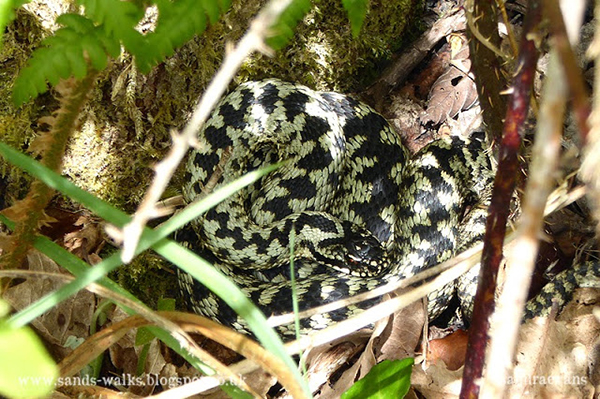
On the 4th May 2015 we saw our first ever adder! We had visited Parc Slip Nature Reserve two weeks previously and walked slowly where they are usually seen, but to no avail we didn't see any. Then on this sunny Saturday we ventured once more and our patience and commitment paid off!

Curled up in the leaves was the most beautiful adder, the colours were so vibrant and he stayed still so we managed to get a few good pics. We were so excited and after a few moments admiring him we left him be and walked around the rest of the reserve. It wasn't long before we ventured back where he was to see if we could see him again and low and behold there he was posing on a log! This time we managed to get video too.

Here are some of the pics and the video...


Video of the adder...


A few other notable creatures were so butterflies, a large white and a speckled wood.

Large white butterfly
Speckled wood butterfly

Thursday, 9 April 2015

Ponds at Night at Parc Slip

On 8th April 2015 we ventured to Parc Slip to do an evening pond watch. The walk was at 8.30pm and seeing as we got there an hour early we parked up and went for a stroll around the reserve. The sun was setting and it looked like it was going to be a lovely evening

Brian the badger with the sun setting behind him
We made our way to the north hide to see what bird activity was around, the beautiful sunset was turning the water a lovely pink colour and there were a number of moorhens and coots on the water. Two Canada geese were strolling on the grass to the left of the scrape and we could see another bird beyond them. With my binoculars I managed to make out that it was a lapwing - our first lapwing sighting of 2015! The lighting wasn't great, but Dan managed to get an awesome pic with his Canon SX50 at full zoom :)

Other creatures that weren't so hard to photograph were the beautiful Highland Cattle. They belong to a local farmer and are kept in this field to improve the habitat for the lapwing by grazing and keeping the turf short. The lapwings prefer the land like this for breeding and the bugs from the cattle manure will be a good source of food for the chicks.

The view from the North hide.
A solo lapwing at full zoom and a very long way away (photo by @danturner23)
One of the highland cattle (photo by @danturner23)
The time was getting on so we started making our way back to the visitor centre. On the way we passed a field full of sheep and lambs and were amused that the lambs were jumping on and off their mum. We also saw a number of small ponds and just happened to spot a great crested newt in one of them. This is the first time I had seen a newt in ages and I knew that the evening was going to be great.

Lambs and their poor mum
Great Crested Newt (photo by @danturner23)
Back at the visitor centre we met our Wildlife Trust guide - a lovely girl called Beth Hopkins and we were joined by another six people. After a quick introduction we were offered torches and we made our way to the first pond behind the visitor centre.

It wasn't long before we were seeing all sorts of pond life: newts, sticklebacks, giant diving beetles and caddisfly larvae - these were really cool. The caddisfly are like architects, using their own silk and whatever they can find to build ornate cases to protect the larvae.

Pond behind the visitor centre
Stickleback and newts
Caddisfly larva in it's DIY protective case
Happy with what we documented here we made our way to the next pond, passing Brian the badger on the way. We couldn't see much activity in the ponds near the front of the visitor centre but the deeper we went into the reserve the more we started to see. We had to be careful where we were stepping because there were newts and toads on the path.

There were alot of deep streams on the side of the paths which were full of activity, one of them had at least four palmate newts in it.

A male toad on the path
One of the streams near the path
Palmate newts in a stream
Close up of a palmate newt
We kept walking around the reserve at a slow pace with just our torches for light. We stopped at any body of water to see what we could find and there wasn't many that didn't have some kind of pond life in them.

I was getting some lovely photos too with newts resting on the surface of the water, including these photos below of a palmate and great crested newt where you are able to see the beautiful bright orange belly.

Palmate Newt
Great Crested Newt
I was extremely interested when I came across a sign containing information about the glow worm - Parc Slip have laid rocks and logs here so that the glow worm can hibernate over winter. It would be so lovely to see a glow worm - I have never seen one in South Wales before.

Not far from here we came across another small male toad with beautiful markings...but this was nothing compared to the beast we encountered a few metres away. It was one of the biggest toads I have ever seen and was a female too - she was awesome, even though she was extremely warty and not very colourful.

Glow worm information
Male toad with beautiful markings - you can tell a male from his 3 black toes
The beast of a female toad - females tend to be larger and more warty than the males
After walking around for over an hour we started to head back to the visitor centre. We were still seeing newts and toads all over the place, we even had to stop while Beth picked up a Great Crested Newt from the middle of the path and placed it back on the grass. She explained that she had a special licence that allowed her to handle these newts. Great Crested Newts are a protected species: the animals, eggs and breeding sites are protected by law and anyone found disturbing them or damaging their habitats would face imprisonment and a £5,000 fine.

The rescued newt in Beth's hand...
...and then safely released into the undergrowth
We had a fantastic time on this pond watch, it was so interesting to see and learn all about these fantastic amphibians. We didn't get to see any frogs unfortunately but seeing the newts made up for it. We have done other walks in Parc Slip including a bat walk and I highly recommend anyone taking part in one of these events. They are a great way to learn and witness nature and with a suggested donation of only £2 per person it's not expensive either. I can't wait to do another one very soon.

Great Crested Newt I spotted on the way back to the visitor centre
Click here for all of the cool events that the Wildlife Trust offers in South and West Wales

Directions to Parc Slip...